STEM drone coding workshops

by Hyett Education
Hyett Education provide a series of STEM workshops that allow students to learn about coding, robotics, engineering, and gain core computing skills. We asked them to tell us more about their drone workshops.
Flying drones sounds like amazing fun, but I imagine there is a heck of a lot of science involved. What sort of topics will children learn about during your STEMdrone workshop?
It is great fun! There's something really wonderful about seeing your code effectively take flight in front of your own eyes. Seeing that transition from paper to a physical object moving creates a lot of excitement.
In terms of learning, we teach the basic principles of flight so students have an understanding of how their code affects the diretcion of travel of the drone and we do that by teaching Swift, which is the language used to program iPhone, iPad and Macbook apps, so the workshop covers a number of objectives in the Computing curriculum and Computer Science curriculum.

What Key Stages and year groups are your drone workshops aimed at, and how can what you teach support their classroom topics?
It's aimed at Upper Key Stage 2 through to Key Stage 4, but unless the students are already coding in Swift it could technically be taught to anyone above the age of ten - I'm sure there are plenty of adults who would find it enjoyable and educational too. Earlier this year we delivered to some 'Gifted & Talented' coders in Year 4 and they were great so we will also look at ways to include younger students or students with special needs when we consult with the school.
We are huge fans of workshops that include problem solving as part of their science offering. Can you talk a bit about how your STEMdrones challenges students to think critically and to work collaboratively?
Me too. As a former teacher I understand all too well how important problem-solving is for developing children. All of our workshops, not just STEMdrones, require collaboration because it's such a fundamental part of working life so we have to foster and develop those skills. I also think it enhances the experience for children, to be able to share ideas and be a part of a team.
We have a variety of collaborative challenges in this workshop but my personal favourite (and I'm sure staff and children love it too based on reactions) is our coordinated drone dance. We create teams that have a 'swarm' of drones and they have to work together to create a drone dance routine with coordinated maneuvers and tricks. It looks absolutely epic when we showcase them at the end of the session. It requires an awful lot of programming, problem-solving and collaboration to make it work and it's the best and most dramatic way to show the students' progress from the start of the session.
Drones are increasingly popular Christmas and Birthday presents but there has been a big push on flight safety. Do you address this or any aspects of actual flight in your workshops?
Yes, absolutely. I'm a CAA approved drone pilot with PfCO (Permission for Commercial Operations) so I have a responsibility to make sure the skills we pass on to the children are used responsibly and they understand the basics of the 'drone code'. Drones aren't dangerous unless they're used irresponsibly and its important people like myself and other drone pilots educate younger people so that they can enjoy using drones safely, and perhaps for some, go on to have successful careers operating them.

How challenging is flying a drone by giving it instructions in the form of computer code, and what prior knowledge of coding do students need?
The session is setup so that the coding is scaffolded and supported so as long as students have basic reading skills they could be a complete novice and still achieve.
To give you an example, we worked with a school recently where the Computer Science teacher was desperate to encourage girls in her school to sign up to her subject because she was really passionate about getting young women in to STEM. The teacher added a few girls to the list who were reluctant to be there because they weren't interested in coding and that was fairly obvious when we started the session. Fast forward to 90 mins later and the same girls didn't want to go out to break because they'd almost cracked one of the drone coding challenges completing a mini-course. It's cliche but those are the moments in educate that stick in your mind and feel the most satisfying.
So, no, students don't need prior knowledge of coding, but it does help.
One last question - how fast do these things fly and how much space to you need to run your workshop?
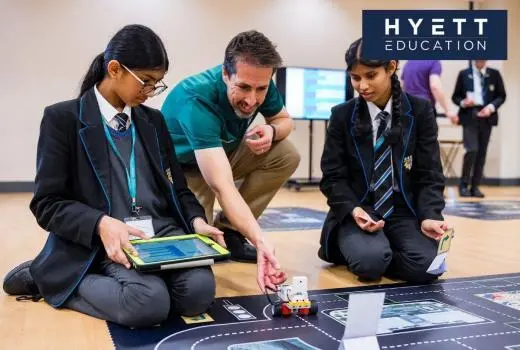
I don't know how fast in terms of mph, maybe that's a maths-based challenge we could setup in future, but they are quite speedy. We have to take precautions to ensure students and staff are safe at all times. We use a large space like a school hall or sports hall, and we setup no-fly zones surrounded by nets to protect students from drones that may have been coded to fly in the wrong direction. Students and staff are also provided with safety glasses and we set clear boundaries and commands for flight operation.
Make a school trip enquiry with Hyett Education
If you are interested in hearing a bit more about how Hyett Education can help you with planning your next school visit then why not get in touch here.