The Future of STEM School Trips

by Educating Adventures
published 2 October 2026
"International trips expose pupils to global scientific contexts, diverse cultural perspectives, and real-world applications that cannot be replicated in the classroom."
- Dr N Kiernan, High School of Dundee, STEM Japan
For generations of students, NASA has been the gold standard of STEM experiences.
Standing where space exploration happens, seeing the science behind some of humanity's greatest technological achievements. Over the summer, I visited myself on our Teacher Preview trip, and it's the kind of visit that can change how a young person thinks about physics, engineering, or their own future. For a student who's been quietly fascinated by astronomy or aerospace, it can make something abstract suddenly feel possible.

But the world of STEM is changing, and so is the way schools are thinking about STEM travel.
Increasingly, educators are looking beyond science centres and space institutions to explore robotics laboratories, AI hubs, advanced manufacturing facilities, smart cities, and technology farms. As Dr Kiernan reflects on a study tour to Japan, the right international experience helps students "make the surreal, real", transforming the concepts they've studied in the classroom into things they can see, question, and understand firsthand.
NASA remains iconic. But it's no longer the only way to give students an extraordinary window into science and technology. Across China, Japan, and Singapore, schools are finding destinations that are just as compelling, and in some ways, even more directly connected to the world students are about to enter.
STEM at its best is about asking bigger questions
STEM education was never really just about formulas and programming syntax. At its most meaningful, it gives students a way to understand how scientific principles are used to solve real problems in a multidisciplinary way.
That might mean seeing a robot perform a task it's been designed for. Understanding how AI is woven into the infrastructure of a city. Exploring how food is grown using hydroponic systems, or how future vehicles might be designed and manufactured.
Educational travel is particularly well suited to this kind of learning because it puts theory into context. Instead of asking "How does this work?", students start asking bigger questions: Why was it built? What problem is it solving? Who uses it, and who doesn't? What happens when a technology changes the way people live?
Those questions turn a STEM trip into something genuinely interdisciplinary. And as Dr Kiernan found, they can "broaden horizons, deepen understanding, and inspire future pathways" both for students and for the staff travelling with them.
China: AI and robotics, up close
For schools exploring artificial intelligence, robotics, and advanced manufacturing, China offers something difficult to find elsewhere: a chance to see these technologies being actively developed and applied at scale.
Hangzhou has emerged as a particularly compelling destination. The city's technology sector gives students a chance to encounter robotics, humanoid machines, and industrial AI in a setting where these aren't exhibits; they're infrastructure. The city's own systems provide a real-world example of AI operating at an urban level, which opens up conversations about smart cities, automation, and what happens when technology becomes embedded in everyday life.
For schools already running robotics or future-skills programmes, this kind of visit has an added dimension. One educator returning from an international STEM trip noted that seeing similar technologies in use overseas offered "the validation that our school's STEM innovation curriculum and robotics courses are on the right track."
That's worth noting. Students aren't the only ones who gain something from these trips.
Japan: Space science, and the questions it raises
Japan offers a different perspective, one where science, engineering, and big questions about the future sit naturally alongside one another.
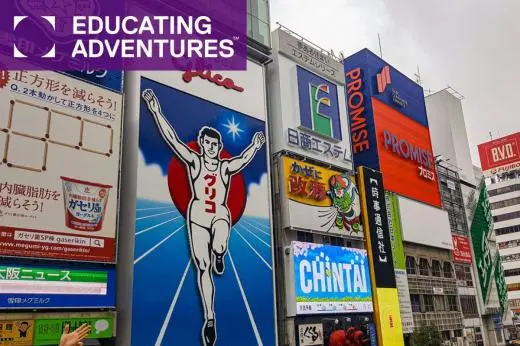
A STEM-focused journey through Japan can weave together space science and physics while pushing students to think beyond the immediate subject content. Space exploration raises questions about human survival, resource management, and engineering on a scale most people never consider. For students, that becomes a powerful bridge across disciplines: physics connects to space, engineering connects to human survival, scientific research connects to the challenges the next generation will need to solve.
Dr Kiernan's experience in Japan also highlights something that's easy to overlook: the value for teachers. Visiting international learning institutions, research facilities, and academic centres gave her school a chance to see how other education systems approach the skills students will need in the future, and to compare those approaches with her own. She observed that institutions overseas taught "similar learning concepts and using the same robotic hardware and software as we did in school."
For curriculum leaders, that kind of professional insight is genuinely valuable.
Singapore: Where robotics meets sustainability
Singapore demonstrates perhaps the most interesting evolution in STEM travel: the connection between technology and the natural world.
Within a compact, highly connected city-state, students can move between robotics demonstrations, advanced manufacturing facilities, and agricultural technology, sometimes within the same programme. At Weston Robot, they can engage hands-on with robot dogs, humanoid robots, and exoskeletons, seeing up close how these technologies work and what they're designed to do. At the Hyundai Motor Group Innovation Centre, they can explore how vehicles and production systems are being reimagined.
But Singapore also offers something less expected: modern farming. At Kok Fah Technology Farm, students can explore hydroponic growing systems and see how science and technology are being applied to food production and sustainability. It's a very different image of what STEM can look like, and a useful one.
That juxtaposition matters. A student might spend a morning exploring AI and robotics, and an afternoon in an environment where technology is being used to grow food more efficiently. Both are STEM. Both are real. Together, they start to paint a more honest picture of the field.

The STEM trip is evolving - and that's a good thing
The most significant shift happening in STEM educational travel isn't about the destinations. It's about what the experience is trying to do.
The strongest programmes are moving away from the traditional model (visit a science museum, hear a presentation, go home) and towards something more connected. Students encounter STEM across an entire destination: in cities, in industry, in agriculture, in research. The result is a picture of the field that reflects what it actually looks like in practice.
That matters because the careers students may eventually enter don't sit neatly within subject boundaries. An engineer working on autonomous vehicles needs to understand more than engineering. A robotics developer needs to think about human interaction. A scientist working on sustainable food production needs to understand environmental systems, economics, and technology. STEM travel can give students an early glimpse of those intersections, before they're expected to navigate them.
NASA still matters. The map is just getting bigger.
None of this is an argument against NASA. Space exploration remains one of the most powerful ways to inspire students, and few experiences can match what a visit there offers.
But STEM itself is broadening, and the destinations available to schools are broadening with it. China, Japan, and Singapore each offer a different window into the technologies and questions that will define the coming decades: AI, robotics, sustainability, advanced manufacturing, the future of food, the future of space.
The common thread isn't the technology itself. It's the opportunity for students to see how people use science to solve problems, create new possibilities, and shape the world around them.
As Dr Kiernan puts it, the right international experience transforms abstract classroom concepts into real-world experiences that stay with students long after they return home.
And perhaps the most memorable STEM trip isn't the one that leaves students thinking, "That was an amazing robot."
It's the one that has them asking: "What could I build, solve, or change myself?"
Make a school trip enquiry with Educating Adventures
If you are interested in hearing a bit more about how Educating Adventures can help you with planning your next school visit then why not get in touch here.