Discover The Birthplace Of In Flanders Fields In Ypres

by Rondo Travel
published 20 April 2026
Discover The Birthplace Of In Flanders Fields In Ypres
Flanders Fields in Belgium holds a place in history unlike any other WW1 battlefield. Canadian military doctor John McCrae wrote In Flanders Fields at Essex Farm, a field dressing station north of Ypres, on 3 May 1915. The poem gave a voice to the dead and turned the red poppy into a global symbol of remembrance.
For teachers planning a school trip, Ypres offers direct access to the poem's birthplace, the battlefield where over one million soldiers became casualties, and the memorials built to honour them. This guide covers the history, the sites, and the practical details your group needs.
What Is Flanders Fields
Flanders Fields refers to the farmland and countryside in the Flanders region of western Belgium where some of the deadliest fighting of World War One took place. The name comes directly from McCrae's poem and now represents the broader battlefield area around Ypres, Passchendaele, Langemark, and Messines.
Before 1914, this area held farms, small villages, and market towns. Four years of trench warfare destroyed everything in sight. Craters, trenches, and bunkers replaced fields and hedgerows. Today, the land has returned to agriculture, but more than 170 Commonwealth cemeteries and dozens of memorials mark what happened here between 1914 and 1918.
Where Is Flanders Fields Located
Flanders Fields sits in the province of West Flanders in western Belgium, close to the French border. The city of Ypres (Ieper in Flemish) serves as the main hub. Ypres lies approximately 120 kilometres west of Brussels and 65 kilometres south of Bruges. The battlefield sites spread across a 30-kilometre radius from Ypres, covering towns including Passchendaele (Passendale), Zonnebeke, Langemark, Messines (Mesen), and Poperinge.
Flanders Fields In Belgium
Belgium's West Flanders province maintains and protects the WW1 heritage of the region. The Flanders Fields area holds UNESCO World Heritage status, with 27 cemeteries and monuments inscribed on the World Heritage List in 2023. Local authorities, the Commonwealth War Graves Commission (CWGC), and the In Flanders Fields Museum all work together to preserve the terrain, maintain the cemeteries, and provide educational resources for visiting schools and groups.
The Birthplace Of The In Flanders Fields Poem
The In Flanders Fields poem was born at Essex Farm, a medical dressing station on the banks of the Yser Canal, roughly 2.5 kilometres north of Ypres city centre. McCrae wrote the poem on 3 May 1915, during the Second Battle of Ypres. He sat on the rear step of a field ambulance, looking out over a makeshift cemetery where wooden crosses marked fresh graves. Red poppies grew between the crosses.
The day before, McCrae had buried his close friend, Lieutenant Alexis Helmer, who died from a German shell. The loss of Helmer, combined with the sight of poppies growing among the dead, drove McCrae to write the 15 lines of verse in fewer than 20 minutes.
Who Wrote In Flanders Fields
Lieutenant Colonel John McCrae, a Canadian military doctor and artillery officer, wrote the poem. McCrae was 41 years old at the time. He served as a brigade surgeon with the 1st Brigade, Canadian Field Artillery, treating wounded soldiers at the Essex Farm dressing station during the Second Battle of Ypres. McCrae had prior military experience from the Boer War and was a qualified physician and pathologist. He died of pneumonia and meningitis on 28 January 1918 at a Canadian military hospital in Boulogne, France. He was 45.
Why The Poem Was Written In Ypres
Ypres in spring 1915 was a place of extreme violence. The Second Battle of Ypres (22 April to 25 May 1915) saw the German army use chlorine gas as a weapon for the first time on the Western Front. Around 100,000 soldiers on both sides became casualties during the battle. McCrae worked at Essex Farm through the worst of the fighting, treating men wounded by gas, shrapnel, and machine gun fire. The conditions at Ypres, the gas attacks, the death of Helmer, and the contrast between the blooming poppies and the surrounding destruction gave McCrae the raw material for his poem.
Flanders Fields During World War One
The Flanders Fields region saw continuous fighting from October 1914 to the final Allied advance in September 1918. The Ypres Salient, a bulge in the Allied front line around the city, became one of the most dangerous sectors on the entire Western Front. British, Australian, Canadian, New Zealand, Belgian, French, Indian, South African, and West African soldiers all fought in the Salient at various points during the war.
The Battles Of Ypres
Historians recognise four major battles at Ypres, though fighting continued on a daily basis for all four years of the war.
The First Battle of Ypres (19 October to 22 November 1914) came during the Race to the Sea, when both sides tried to outflank each other. Allied and German casualties combined exceeded 220,000. The battle destroyed the pre-war British Expeditionary Force, with the British suffering over 54,000 killed, wounded, and missing.
The Second Battle of Ypres (22 April to 25 May 1915) introduced chemical warfare. German forces released chlorine gas on 22 April, creating a gap in Allied lines. Canadian troops held the line against repeated attacks. Total casualties reached approximately 100,000 on both sides.
The Third Battle of Ypres (31 July to 10 November 1917), also called Passchendaele, lasted over 100 days. British and Allied forces advanced approximately five miles at a cost of over 250,000 casualties. German losses exceeded 200,000. The battle name Passchendaele became synonymous with mud, blood, and futility.
The Fourth Battle of Ypres (7 to 29 April 1918) formed part of the German Spring Offensive. Combined casualties across all four major battles surpassed one million.
Why Flanders Fields Became A Major Battlefield
Geography turned Flanders Fields into a killing ground. Ypres stood in the path of Germany's planned sweep across Belgium as part of the Schlieffen Plan. The city sat at a crossroads of major supply routes and controlled access to the Channel ports. The surrounding terrain, flat and low-lying with a high water table, turned to deep mud whenever rain fell or artillery destroyed the drainage systems. Troops on both sides dug trenches through waterlogged clay, creating conditions of extreme misery.
The Ypres Salient, surrounded by German-held high ground on three sides, left Allied positions exposed to observation and fire from elevated positions along ridges at Passchendaele, Messines, and Hill 60.
Memorial Sites Across Flanders Fields
More than 170 Commonwealth cemeteries and numerous memorials mark the Flanders Fields battlefield. Three sites stand out as essential stops for school groups visiting Ypres.
Menin Gate Memorial
The Menin Gate Memorial stands at the eastern exit of Ypres, on the road soldiers marched along to reach the front line. Designed by Sir Reginald Blomfield and unveiled on 24 July 1927, the memorial carries the names of 54,389 officers and men from British and Commonwealth forces who died in the Ypres Salient before 16 August 1917 and whose graves have never been found.
Every evening at 8pm, buglers from the local fire brigade sound the Last Post beneath the arches of the Menin Gate. This ceremony has run every evening since 1928, pausing only during the German occupation in World War Two. The Last Post ceremony resumed on 6 September 1944; the day Polish forces liberated Ypres.
For school groups, the Last Post ceremony provides one of the most moving educational experiences available on any WW1 battlefield tour. Students stand beneath the arches surrounded by the carved names of the missing and hear the same bugle call sounded for almost 100 years. Rondo Travel arranges evening itineraries so your group arrives at the Menin Gate in time for the ceremony.
Tyne Cot Cemetery
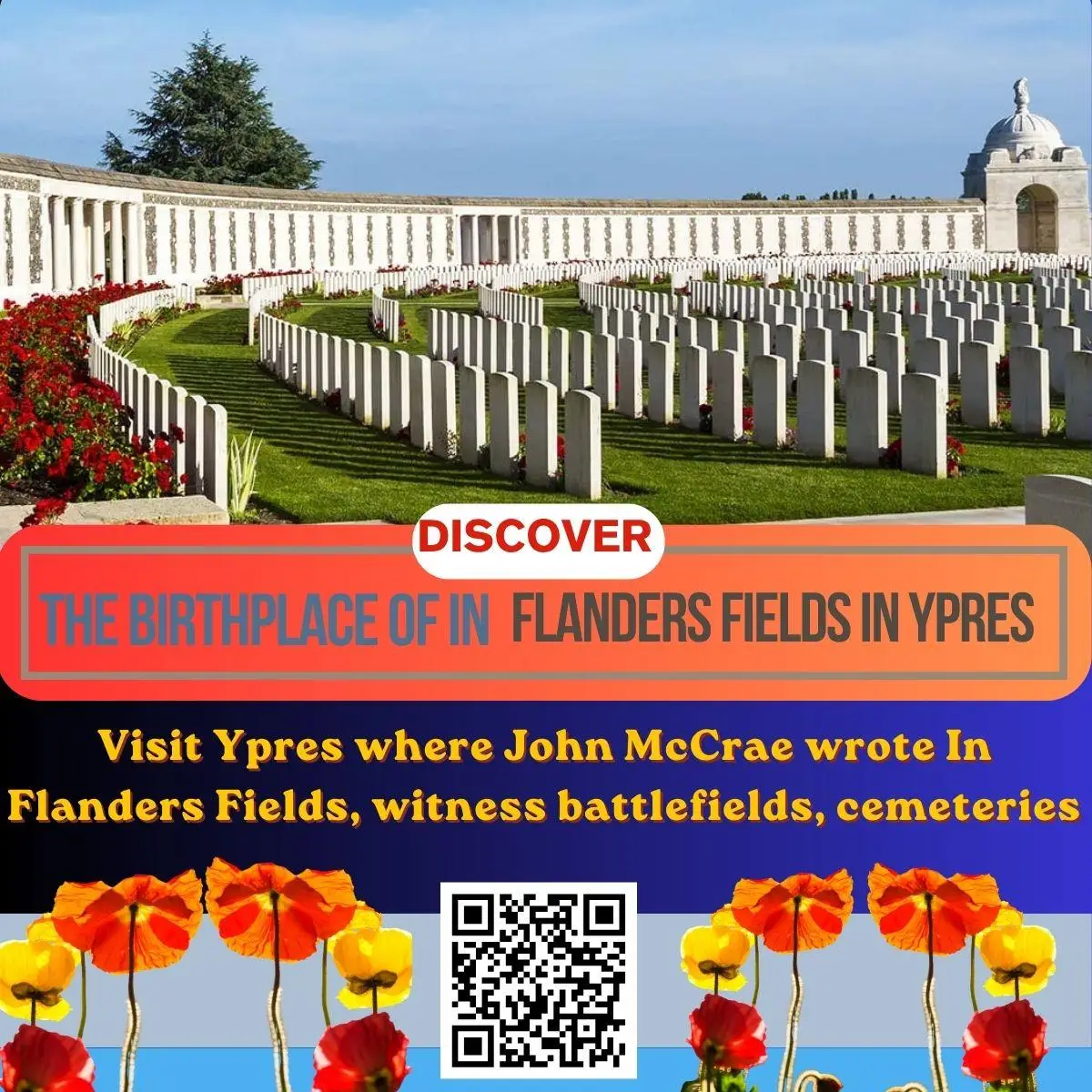
Tyne Cot Cemetery near Passchendaele holds 11,961 Commonwealth burials, the largest Commonwealth war cemetery in the world. Of those burials, 8,373 remain unidentified. The Tyne Cot Memorial wall forms the rear boundary of the cemetery and carries the names of nearly 35,000 soldiers from UK and New Zealand forces who died after 16 August 1917 and have no known grave.
The cemetery sits on a ridge captured by the 3rd Australian Division on 4 October 1917 during the Battle of Broodseinde. Three German concrete pillboxes remain visible among the headstones. King George V visited in 1922 and suggested placing the Cross of Sacrifice on top of the largest captured pillbox, where a wall section remains visible at ground level.
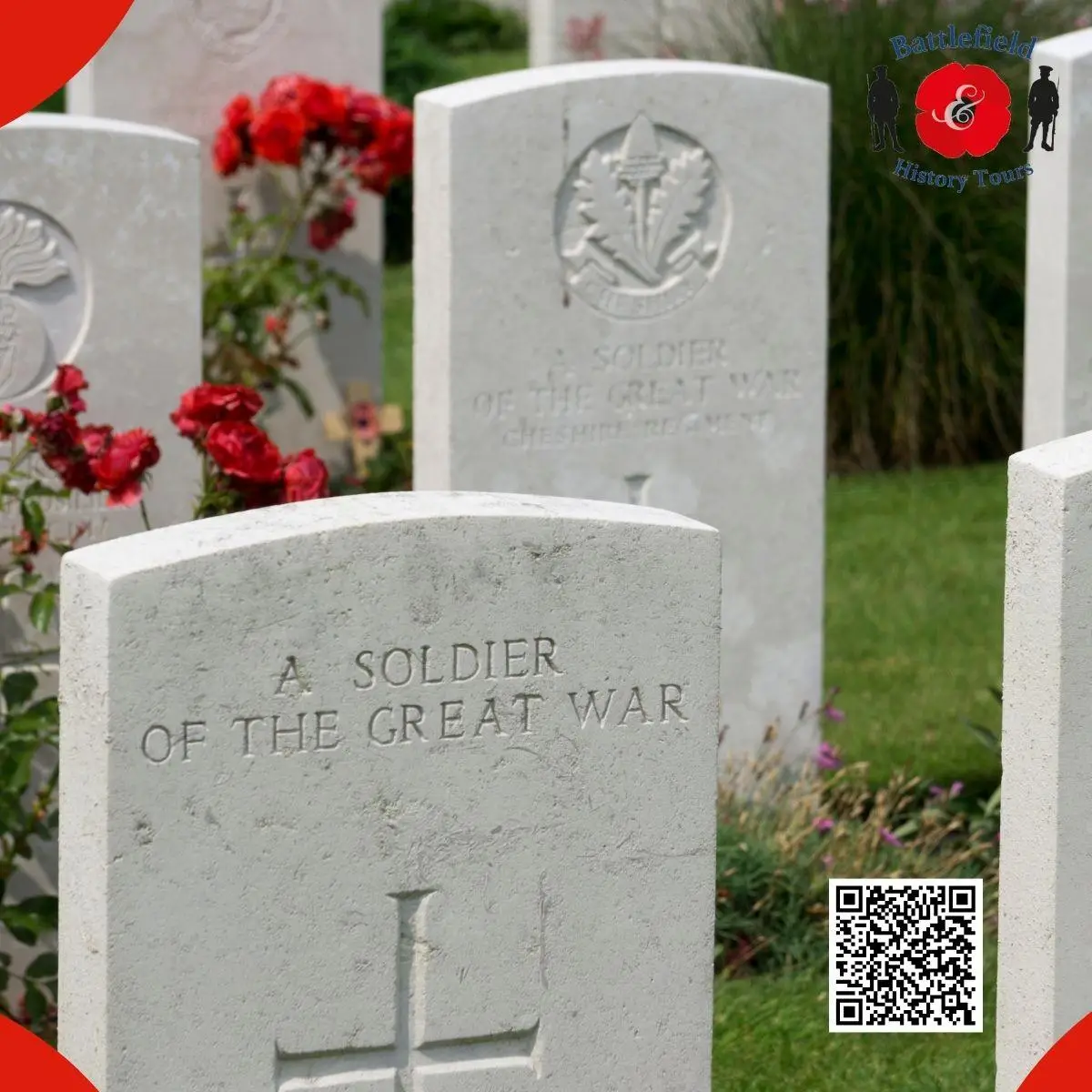
A free visitor centre behind the cemetery provides context and information. Students walk through row after row of white Portland stone headstones, each representing one soldier. The scale of loss becomes physical and visible in a way no textbook achieves.
In Flanders Fields Museum
The In Flanders Fields Museum occupies the upper floors of the restored Cloth Hall on the Grote Markt (main square) in Ypres. The Cloth Hall, a medieval trading building destroyed during the war, was rebuilt between 1933 and 1967 as a faithful reconstruction of the original.
The museum uses interactive exhibits, multimedia displays, personal stories, and original artefacts to guide visitors through the history of WW1 in the Flanders region. Each visitor receives a poppy bracelet programmed with the identity of a real person who experienced the war. At touchpoints throughout the exhibition, the bracelet reveals personal details of the assigned individual, connecting students to a single life amid the broader conflict.
The museum covers topics across multiple curriculum subjects, from history and English literature to geography, art, and ethics. Teachers planning a visit receive dedicated educational resources and guided tour options tailored to GCSE and A-Level specifications.
Why Flanders Fields Became A Symbol Of Remembrance
McCrae's poem gave the world a single, enduring image of the First World War. The lines connected grief, duty, and nature in 15 verses short enough to memorise and resonant enough to last. The poem appeared in Punch magazine on 8 December 1915 and spread rapidly. By the end of the war, In Flanders Fields had become the most widely known war poem in the English-speaking world.
The Meaning Behind The Poppy Symbol
Red corn poppies (Papaver rhoeas) grew in the disturbed soil of the battlefields because artillery fire turned over the earth and brought dormant seeds to the surface. The poppies bloomed in the spring and summer of 1915 between the wooden crosses of the cemeteries and across the churned ground.
McCrae's poem connected the poppy to remembrance. In 1921, the Royal British Legion adopted the red poppy as an emblem for Remembrance Day, following the lead of American academic Moina Michael, who campaigned for the poppy as a memorial symbol after reading McCrae's poem in 1918. Today, the poppy remains the primary symbol of WW1 remembrance in the United Kingdom, Canada, Australia, and New Zealand.
The Global Legacy Of The Poem
In Flanders Fields is recited at Remembrance Day services on 11 November in countries across the world. The poem appears on the Canadian ten-dollar bill (older series) and is quoted at the annual ANZAC Day services in Australia and New Zealand. Schools across the UK study In Flanders Fields as part of GCSE English Literature and History syllabuses, making a visit to its birthplace at Essex Farm a direct link between classroom learning and real-world evidence.
Visiting Flanders Fields Today
A school trip to Flanders Fields gives students direct access to the battlefields, memorials, and museums they study in the classroom. Ypres serves as the base for all visits, with accommodation ranging from hostels to four-star hotels. Battlefield & History Tour works with established local providers and assigns a dedicated tour manager to your group from the UK departure point through to your return.
WW1 Battlefield Sites Around Ypres
Beyond the three main sites listed above, school groups visiting Ypres regularly include Essex Farm Cemetery and John McCrae Memorial Site (the poem's birthplace, with the preserved dressing station bunkers), Talbot House in Poperinge (a rest house for soldiers, preserved to reflect wartime conditions), and Hill 60 (a strategic position with visible craters and trench remains from mining warfare). Each site adds a different perspective to the trip, from the literary history at Essex Farm to the engineering and technology aspects of mine warfare at Hill 60.
Museums And Memorials In Ypres
Ypres city centre itself functions as a memorial. The rebuilt Cloth Hall, the medieval ramparts, the cathedral, and the network of streets all stand on foundations destroyed during the war. The In Flanders Fields Museum anchors the educational experience, with additional resources available at the Passchendaele Museum in Zonnebeke (10 km east of Ypres), where students walk through a reconstructed trench system and dugout.
Our Battlefield and History Tours brand offers focused itineraries with the emphasis on subject matter rather than a generalist tour. Many school groups choose a full-time battlefield guide who joins the group from the UK departure point and provides ongoing commentary during travel between sites. This format allows students to absorb context and ask questions throughout the journey, not only at designated stops.
Plan Your Ypres School Trip with Battlefield & History Tour
Battlefield & History Tour designs every Ypres school trip around your group's learning objectives and curriculum requirements. Your dedicated tour manager collaborates with you on itinerary planning, accommodation, transport, and site visits. All tours include ABTA and ATOL financial protection, STF Travel insurance, and complimentary staff places at a 1:10 ratio.
We arrange coach travel with Channel crossing or direct flights to Belgium. All flight-inclusive tours carry ATOL protection. Contact us to build a bespoke Ypres battlefield tour for your students.
Frequently Asked Questions
What is the origin of the In Flanders Fields poem?
Canadian military doctor John McCrae wrote In Flanders Fields on 3 May 1915 at Essex Farm, a field dressing station 2.5 km north of Ypres, Belgium. He composed the poem after burying his friend Lieutenant Alexis Helmer, who died from a German shell the previous day.
Where is Flanders Fields located in Belgium?
Flanders Fields sits in the province of West Flanders in western Belgium. The city of Ypres (Ieper) is the main hub, located approximately 120 km west of Brussels. The battlefield sites spread across a 30 km radius from Ypres.
Why is Flanders Fields famous in World War One?
Flanders Fields saw continuous fighting from 1914 to 1918. Four major battles at Ypres produced combined casualties exceeding one million soldiers. The area also gave rise to the most famous war poem of WW1, In Flanders Fields, and became the origin of the poppy as a symbol of remembrance.
Is Ypres located in Flanders Fields?
Yes. Ypres (Ieper) is the principal city in the Flanders Fields region. The city served as the centre of the Ypres Salient, the frontline bulge in Allied defences, throughout WW1.
What happened in Flanders Fields during WW1?
Four major battles took place at Ypres between 1914 and 1918, with daily skirmishes and raids between the larger operations. The Second Battle of Ypres (1915) saw the first mass use of chlorine gas. The Third Battle, Passchendaele (1917), produced over 450,000 casualties on both sides.
Which battle is connected to the In Flanders Fields poem?
McCrae wrote the poem during the Second Battle of Ypres (22 April to 25 May 1915), the battle in which German forces first used poison gas on the Western Front.
Why are poppies associated with Flanders Fields?
Red corn poppies grew in the disturbed soil of the battlefields because artillery turned over the earth and brought dormant seeds to the surface. McCrae's poem connected the poppy to remembrance. The Royal British Legion adopted the poppy as a memorial emblem in 1921.
How many soldiers died in the battles of Ypres?
Combined casualties across the four major Battles of Ypres exceeded one million soldiers killed, wounded, and missing. The Third Battle of Ypres (Passchendaele) alone produced over 450,000 casualties on both sides. The CWGC maintains more than 170 cemeteries in the Flanders Fields area.
What memorials can be visited in Flanders Fields?
The main memorial sites include the Menin Gate Memorial (54,389 names of the missing), Tyne Cot Cemetery (11,961 burials, nearly 35,000 additional names on the memorial wall), Essex Farm Cemetery, Langemark German Military Cemetery, Hill 60, and the In Flanders Fields Museum in the Cloth Hall at Ypres.
What is the In Flanders Fields Museum in Ypres?
The In Flanders Fields Museum occupies the upper floors of the rebuilt Cloth Hall on the main square in Ypres. The museum uses interactive exhibits, multimedia presentations, and personal artefacts to tell the story of WW1 in the Flanders region. Visitors receive a poppy bracelet linked to a real person who experienced the war, creating a personal connection throughout the exhibition.
Make a school trip enquiry with Rondo Travel
If you are interested in hearing a bit more about how Rondo Travel can help you with planning your next school visit then why not get in touch here.