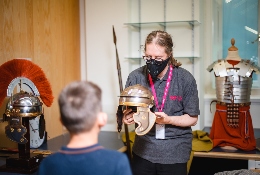
The 1620s House is a wonderful venue for creative educational experiences within a truly historical setting. Sessions led by costumed characters delivered for EYFS and KS1 - 2 groups with links to history, science, PHSE and English. Our unique site is also available for educators to deliver their own sessions using the building, content and gardens for inspiration to deliver cross-curricular activities. You can bring your family to the site for FREE for a school pre-visit during our open season.


What activities are available during educational visits?
The session 'Step Inside the Manor' forms part of a local study which looks at significant historical events, people and places in their own locality. It looks at the life of the family which lived in the house in the 1620s. The costumed character-led session helps pupils to understand the complexity of people's lives and the importance of roles within a household. The aim is to equip pupils to ask perceptive questions, think critically and weigh the evidence as well as to listen, understand and respond appropriately to others and to extend and follow their own ideas. For 'Plants, Plagues and Potions', pupils can learn more about the vast array of plants in the garden, and understand how they might have been used to cure different ailments - perhaps even have a go at making their own remedy! They will then learn about the house's connection with Religion and Witchcraft during this turbulent period in history. Lady Digby will make an appearance if you book 'Gunpowder Plot', and explain the house's connection to this infamous event. Pupils will learn about the history and politics leading up to this, and craft their own Guy peg doll to take home.
Which curriculum topics do we cater for?
Tudors School Trip
Guy Fawkes Gunpowder Plot
Visitors can now see the beautifully restored period rooms and talk to our volunteers about the history of the house, the families that lived here and about life in the 1620s. The house is set in beautiful 17th century style gardens with labelled plants and flowers, an orchard, herb gardens and a small maze, allowing visitors to learn more about the Tudors and Stuarts.
Every year we tell the entertaining story behind the Gunpowder Plot. Discover how the family that lived in the 1620s House were connected to it. SPOILER! Their uncle, Everard Digby, was hung, drawn and quartered for his part in it!
Historic Events Beyond Living Memory
>English
>Significant Individuals from History
>What size groups do we cater for?
The site can cater for a group of up to 33 pupils on one day.
On-site classroom facilities?
The school group has access to the house, the barn - where they can participate in activity and have their lunch - and the gardens. It is usually standard that the public are not given access to the site when schools groups are booked in.
Is there first aid on site?
Due to the nature of the site, schools are required to bring their own first aider and equipment.
Groups with Special Educational Needs & Disabilities (SEND)
We tailor our sessions to cater for a mixture of special educational needs.
Yes, we have a disabled toilet.
Teacher Checklist
Get Risk Assessments
Anything else?
The 1620s House and Garden has recently won the prestigious "Hidden Gem" Award. Furthermore, all our programmes were designed as part of an Art and STEM project: "Project Enlightenment". We have looked to unite History and Science in a way that celebrates both the past and the present at this beautiful location.
Through the application of multi-disciplinary art forms we will be looking at the 17th Century shift from witchcraft, alchemy and superstition to observations, experiments and analytical theory including, for example, the invention of the telescope, new laws of motion and gravity, and the new science of microscopy. We will be researching, investigating and experimenting with artists to recreate the 17th Century scientific discoveries to encourage pupils and families to recognise and nurture their own curiosity in the 21st Century.
There are different ways in which schools can participate - you can either book on to a one-off visit to the 1620s House to take part in a range of activity or you can take part in one of the artist-led residencies which will include active participation in the house and in your school.
Who are 1620s House and Garden?
The 1620s House & Garden at Donington le Heath is one of the oldest houses in Leicestershire, built around 1290. In 1536 Henry VIII sold the house to the Digby family after the dissolution of Ulverscroft Priory, which owned the house at that time. John Digby modernised some of the windows and the roof during the 17th Century but the most famous Digby family member was Sir Everard Digby, who was hung, drawn and quartered for his part in the conspiracy to kidnap Princess Elizabeth from Coombe Abbey during the Gunpowder Plot of 1605. In 1963 the house was listed as an ancient monument and in 1965 Leicestershire County Council bought the house and began a full restoration, which took seven years. Now the 1620s House is a surviving example of a family home built around 700 years ago with beautiful reconstructed gardens. The site is perfect for pupils to inspire and to be inspired.

Every enquiry gives you a chance to win trips and workshops for your school - We are giving away a free trip for every week of the Autumn term!
 Coalville Leicestershire LE67 2FW